

Hong Kong
Vietnam
Philippines
Singapore
Thailand
Japan
UAE
Egypt
China
South korea
Malaysia
BY FELIX TRAN • 14 JULY 2026

A client once told us they wanted “something to break the ice” and “something to keep the energy up all day” in the same sentence, as if they were the same thing.
They’re not. This mix-up happens more often than you’d think, and it usually leads to the wrong activity showing up in the wrong slot on the agenda.
Icebreakers vs fringe activities comes down to timing and purpose. Icebreakers open the room. Fringe activities keep it energised.
In this guide, we’ll define both terms clearly, compare them side by side, and show you exactly when to use one, the other, or both. By the end, you’ll know how to brief your event partner correctly and stop wasting budget on the wrong tool for the job.
Icebreakers are short, structured activities designed to reduce social friction at the very start of an event or session. They’re quick by design. Most run 5 to 15 minutes, right at the beginning, before the “real” programme kicks off.
Common formats include:
Think of a speed-networking-style round where attendees answer quick questions in pairs, or a personalised name tag with an “ask me about…” prompt. Both get people talking fast, without needing much setup.
The right icebreaker depends on your group. A room full of strangers at a conference needs something different from a team that’s worked together for years.
At Dream Station, we build icebreakers into the opening of nearly every event we run. It’s one of the smallest details on the run sheet, but it sets the tone for everything that follows. Learn more about how we structure team building experiences that start strong.
Fringe activities are supplementary entertainment or experiential elements that run alongside your main event programme — not just at the start, but throughout.
Where icebreakers are a single opening moment, fringe activities are designed to sustain energy across breaks, receptions, and downtime for the whole event.
Common formats include:
Picture a photobooth or claw machine station tucked into a conference networking break, or a live caricature artist circulating during a dinner and dance. These elements give attendees something to do and something to talk about between the scheduled sessions.
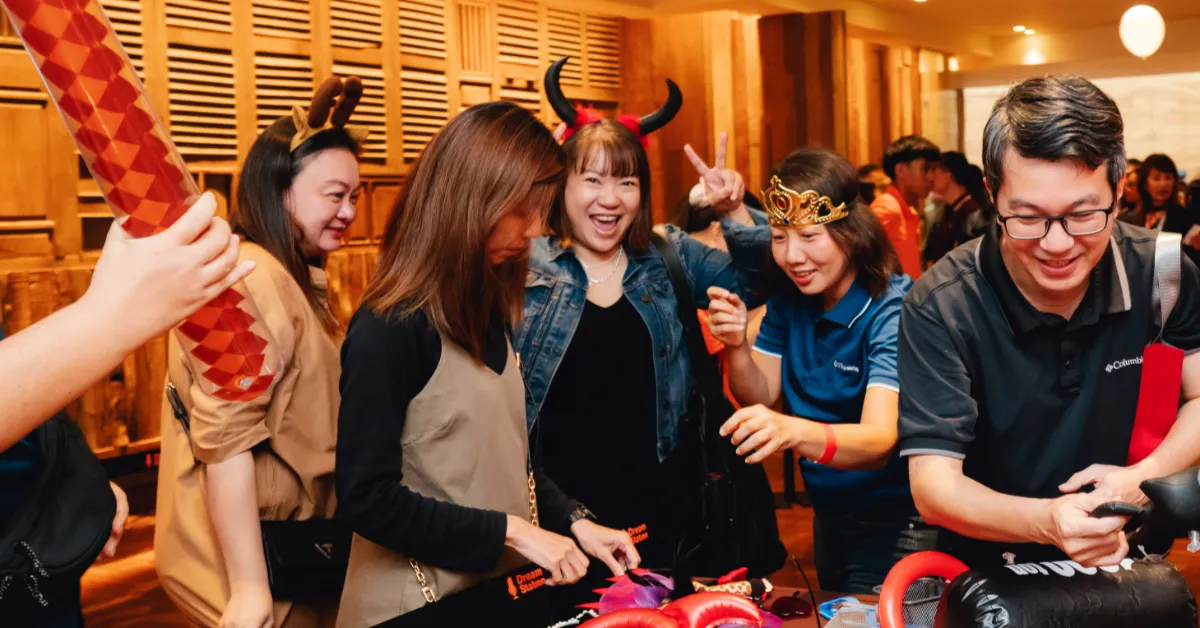
Fringe activities matter most when your event has real downtime to fill: long conferences, exhibitions, or expos where attendees need an extra draw to stay engaged.
Dream Station runs a dedicated fringe activities service, built from years of delivering these elements at large-scale conferences, grand openings, and exhibitions across APAC. We know which activities land with which crowds and which fall flat.
The clearest way to separate these two is a side-by-side comparison across five criteria.
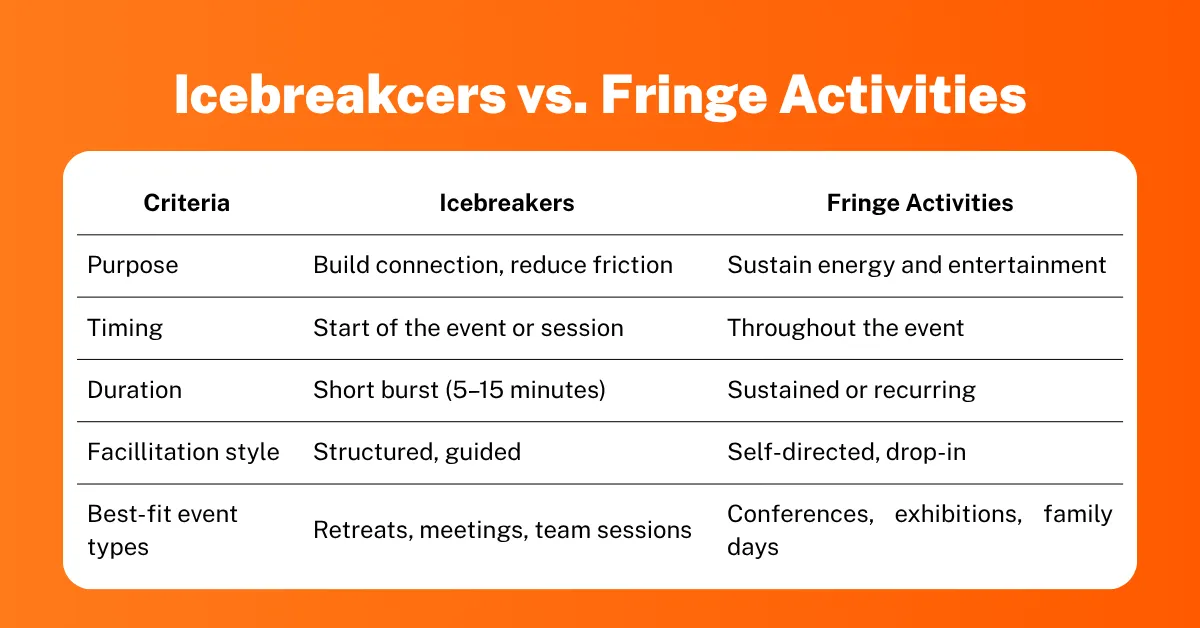
Use this table as a checklist when you brief your event planner. If you ask for “something fun” without specifying which of these you need, you risk paying for a fringe activity when what you actually needed was a fast, guided opener — or vice versa.
This is exactly why Dream Station builds this assessment into the discovery phase of every project. We ask what problem you’re solving, connection or energy, before we recommend a solution.
Most events don’t need to choose. They need both, placed deliberately across the agenda.
Start by mapping your event’s shape:
A one-day conference might open with a quick icebreaker at registration, then run fringe activities like a photobooth or games corner through the networking breaks and lunch. A multi-day company retreat could use a fresh icebreaker at the start of each new session, with fringe activities woven into the evening social time.

The pattern is simple: icebreakers sit at transition and opening points, while fringe activities fill the extended or unstructured blocks in between.
Dream Station designs full event flows this way — mapping icebreakers and fringe activities into the agenda together, rather than bolting them on as an afterthought. It’s part of how we approach every corporate event management project, whether it’s a 50-person offsite or a 1,000-person conference.
Icebreakers and fringe activities solve different problems. One opens the room. The other keeps it energised. The best events don’t pick a side. They sequence both deliberately, so attendees stay engaged from the first minute to the last. If you need help designing an agenda that blends icebreakers and fringe activities effectively, we are happy to help.
We'll get back to you as fast as we can with availability and next steps.


Hong Kong
Vietnam
Philippines
Singapore
Thailand
Japan
UAE
Egypt
China
South korea
Malaysia

OUR GLOBAL PRESENCE